
Most people judge water by what they can see. If it looks clear, smells neutral, and tastes fine, it’s usually considered safe. That’s understandable — after all, our senses are the quickest tools we have.
But here’s the thing: some of the most important aspects of water quality are completely invisible.
Bacteria, microscopic organisms, and certain contaminants don’t change the appearance of water at all. You could pour a glass that looks perfectly pure, yet still contains elements that affect health over time.
That quiet reality is why water treatment has evolved far beyond simple filtration.
Why Water Safety Goes Beyond Appearance
Clear water doesn’t always mean clean water.
Municipal treatment facilities work hard to meet safety standards, and in most cases, they do a solid job. But those systems focus on large-scale distribution, not individual household conditions.
By the time water travels through miles of pipelines and enters a home’s plumbing network, it may encounter additional variables — aging pipes, storage tanks, or environmental exposure.
These factors can introduce microscopic contaminants that remain undetectable without specialized treatment.
That’s where advanced purification methods come into play.
The Difference Between Filtration and True Purification
It’s easy to assume that filtration and purification are the same thing.
They’re not.
Traditional filtration systems typically remove particles like sediment, rust, and certain chemical residues. They improve clarity and taste, which is important.
But purification goes deeper.
True water purification focuses on eliminating microorganisms and dissolved contaminants that basic filters can’t capture.
This distinction is crucial for households concerned about biological safety rather than just visual cleanliness.
Understanding the Risks of Microbial Contamination
Microorganisms in water aren’t always dangerous, but some can pose health risks, particularly for vulnerable individuals.
Bacteria, viruses, and protozoa can enter water supplies through environmental runoff, infrastructure issues, or local contamination events.
Even well-maintained systems can experience occasional fluctuations in microbial presence.
The challenge lies in detection — these contaminants don’t announce themselves.
They don’t change water’s color or taste.
They simply exist silently, which is why specialized treatment technologies are designed to address them.
How Ultraviolet Technology Works
One of the most effective methods for eliminating microorganisms involves ultraviolet water filtration.
This technology uses UV light at specific wavelengths to disrupt the DNA of bacteria and viruses, preventing them from reproducing.
Unlike chemical treatments, ultraviolet systems don’t add substances to water.
They work quickly, efficiently, and without altering taste or odor.
The process happens inside a sealed chamber, making it safe and reliable for continuous use.
For many households, this approach offers an extra layer of confidence in water safety.
Why Chemical Disinfection Isn’t Always Ideal
Traditional disinfection methods often rely on chlorine or similar chemicals.
While effective at killing microorganisms, these treatments can introduce new challenges.
Chlorine may affect water taste and smell. It can also react with organic materials to form byproducts that some homeowners prefer to avoid.
Ultraviolet systems provide an alternative approach — eliminating microorganisms without chemical additions.
This makes them particularly appealing for individuals seeking more natural treatment options.
The Role of UV Systems in Comprehensive Treatment
Ultraviolet treatment rarely functions alone.
Instead, it typically works as part of a multi-stage system.
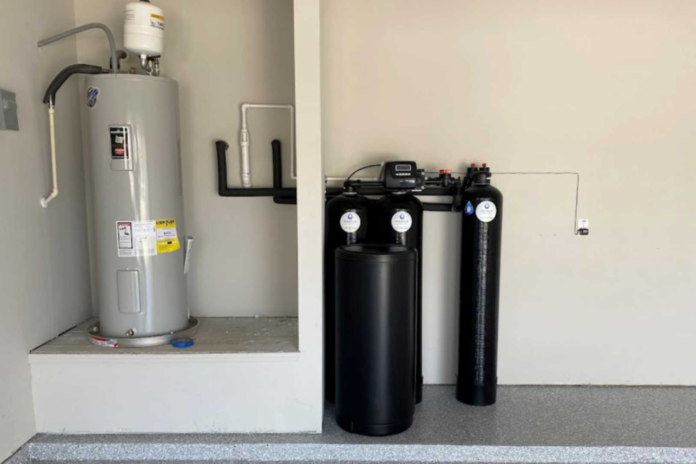
Pre-filtration removes sediment and particles that could block UV light, ensuring maximum effectiveness.
Post-treatment filtration may address chemical contaminants or mineral content.
This layered approach creates a comprehensive treatment process that addresses multiple aspects of water quality simultaneously.
The Importance of Bacteria Control in Household Water
For many homeowners, bacteria removal represents one of the most critical aspects of water treatment.
This concern is especially relevant for households relying on private wells or living in areas with aging infrastructure.
Even small amounts of bacterial contamination can affect health over time.
Effective treatment provides reassurance that water is not only clean in appearance, but also microbiologically safe.
That peace of mind often becomes one of the most valuable benefits of advanced systems.
How Water Quality Influences Daily Living
Improved water quality often produces subtle yet meaningful changes.
Drinking water tastes fresher. Ice cubes appear clearer. Cooking results may even improve.
For families, especially those with children, knowing water is thoroughly treated reduces concerns about safety.
The transformation isn’t dramatic — it’s quiet and consistent.
And over time, it becomes an essential part of daily comfort.
Environmental Benefits of Non-Chemical Treatment
Ultraviolet systems also offer environmental advantages.
Because they don’t rely on chemical additives, they reduce the introduction of disinfectant byproducts into wastewater systems.
They also minimize the need for bottled water, lowering plastic waste.
This combination of effectiveness and sustainability aligns with growing environmental awareness among homeowners.
Maintenance and Long-Term Reliability
Like any treatment system, ultraviolet filtration requires regular maintenance.
UV lamps typically need periodic replacement to maintain effectiveness.
However, maintenance is generally straightforward and predictable.
When properly maintained, UV systems provide reliable, long-term protection against microbial contamination.
Their simplicity contributes to their popularity in both residential and commercial settings.
The Psychological Comfort of Invisible Protection
There’s something uniquely reassuring about knowing your water is protected against invisible threats.
Even though you can’t see bacteria or microorganisms, knowing they’re effectively neutralized provides a sense of security.
This psychological comfort often becomes one of the most appreciated aspects of advanced water treatment.
It transforms uncertainty into confidence.
Final Thoughts: Seeing Beyond What the Eye Can Detect
Water quality is more complex than appearance alone can reveal.
What looks clean may still contain microscopic elements that affect health and safety.
By understanding the limitations of visual assessment and embracing advanced purification technologies, homeowners can take proactive steps toward better water quality.
Because in the end, truly clean water isn’t just about clarity.
It’s about confidence in every invisible detail that makes it safe to drink, use, and trust every day.

